
This isn’t the story of how I became an art therapist. It’s the story of how I spent years trying to find my way back to myself.
I am
Magdolna Nađ Torma
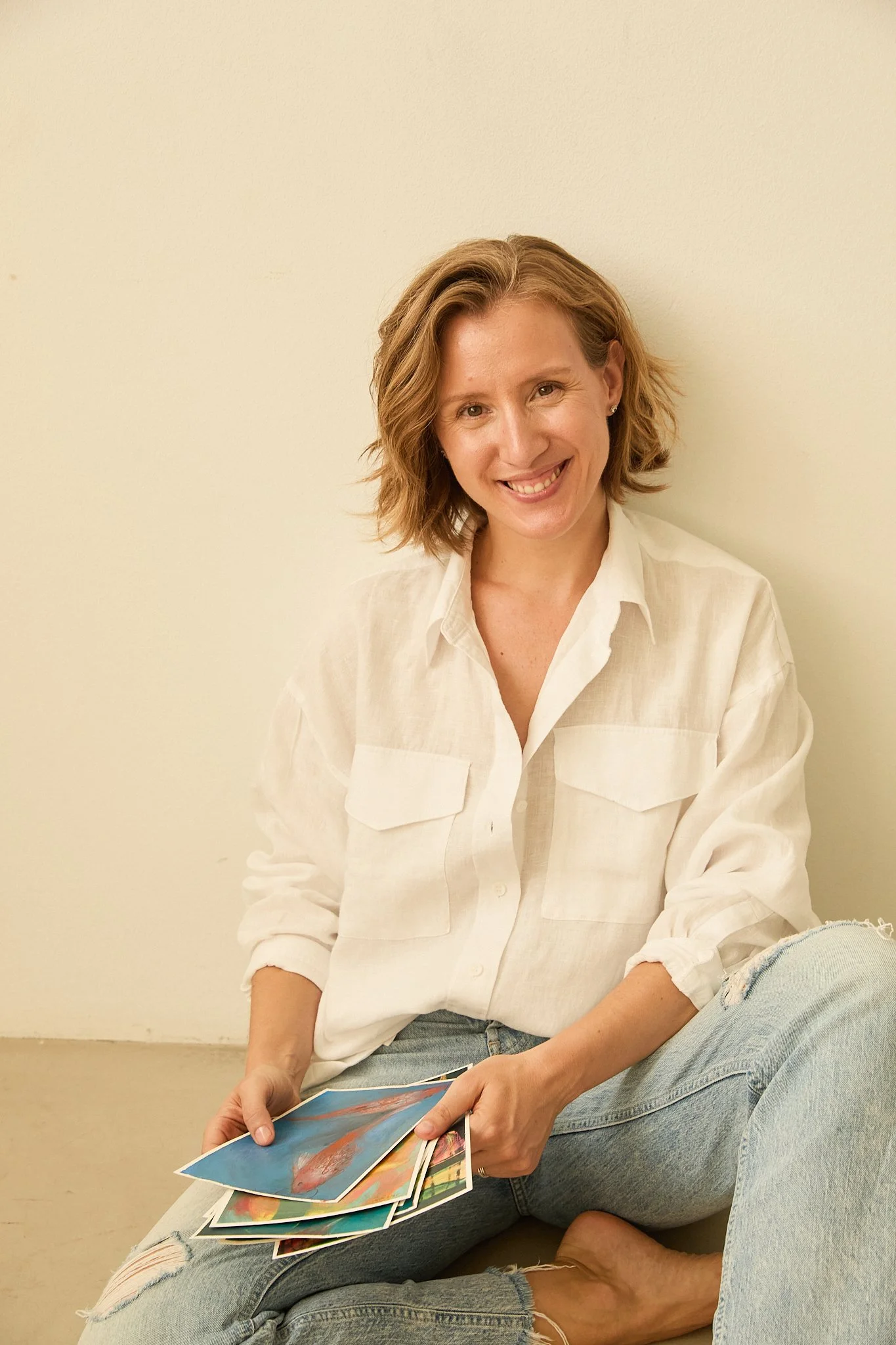

An experienced
Artist, Art Therapist, and Life Coach.
If you're meeting me for the first time, welcome.
I grew up in a family where meditation, conversations about emotions, and books by Louise Hay and Napoleon Hill were part of everyday life — long before any of that became popular. Being different wasn't a choice. It was a way of life. Curiosity was an integral part of our upbringing. Everything my parents explored, my sister and I applied.
At that time, I didn't know that it was precisely this curiosity about human nature, emotions, and different approaches to personal development that would one day lead me to art therapy.
At eighteen I decided to enrol in the Academy of Fine Arts. Despite all the advice to choose a safer path, I had no plan B. I still remember the butcher at the supermarket who asked me: “And what will you do if you don’t get in?”
My mother didn’t share that worry. She told me only one thing: “You can achieve anything you want.” That sentence became my inner anchor — a mantra I returned to many times throughout my life.
At the Academy, I was happy. I drew and painted all day. The first two and a half years were the best of my life.
Then something happened that would change my relationship with myself and with art for the next fifteen years.
A professor whose romantic advances I rejected began slowly eroding my confidence. He planted doubt, questioned my talent, and led me to believe that I had potential I’d never managed to develop. I didn’t go from the best student in the class to the worst. I became invisible. I think that hurt more than any criticism could have.
Today I know it is far easier to believe someone else’s voice than to keep believing your own.
Shortly after, I moved to Milan for postgraduate studies, hoping for a fresh start. At the entrance interview, the professor looked at my work, pushed it aside, and said: “Forget everything you’ve done until now. Here we start from zero.” Those words only confirmed what I had already begun to believe — that I wasn’t good enough.
Sometimes all it takes to lose confidence is one sentence, said at the moment when we are most vulnerable.
For years afterward, I barely painted. I made collages and used old family photographs because I was convinced I no longer knew how to draw. Today I know that wasn’t a new artistic expression. It was my way of protecting myself from self-doubt.
The "Excellent Student" Trap
I began searching for answers everywhere: Psychology, Reiki, Kundalini, Astrology. I was becoming a Straight-A student of personal growth. I could explain my trauma, I could map my childhood, and I could "perform" a perfect therapy session—arriving with a mental bullet-point list of my breakthroughs while my shoulders and neck remained as tight as ever.
I wasn’t looking for a new method — I was desperately searching for a way to believe in myself again.
Then something shifted. When I exhibited my Happy Family series in Dubai, I saw for the first time how deeply art can touch people. Their reactions were far stronger than I expected. For the first time, I seriously began to think that art could be so much more than a painting on a wall.
Others often see our value long before we are ready to see it ourselves.
Shortly after, I discovered art therapy. Everything I had been searching for years suddenly made sense.
During my practical training I worked with teenage girls who had been separated from their families due to difficult circumstances. Their pain overwhelmed me so completely that I seriously considered quitting. I wasn’t doubting art therapy — I was doubting myself again. I was convinced I didn’t have the capacity to be present with that much pain. But I stayed. That was the first time I truly understood how important it is for at least one person to believe in you when you cannot yet believe in yourself.
Years later I enrolled in the Master’s in Gestalt Art Therapy. It was there that I admitted to myself for the first time that what happened at the Academy had actually happened. For years before that I had said: “Nothing happened.” Today I know that was my way of protecting myself. Only when that protection was no longer needed could I begin to heal.
I started drawing again. One hundred days in a row. Every day, the same voices greeted me: “This is ugly.” “People will laugh at you.” “See, he was right.” “Give up.” “It’s too late.” The voices didn’t disappear. The difference was that this time I didn’t believe them. I kept drawing in spite of the fear. Because I no longer wanted to miss my own life.
And that’s when it began to return — trust in myself, in my talent, in my identity as an artist.
When my father died, I turned to the same tools I use with my clients today. This time I didn’t want to escape grief — I wanted to let myself live through it. From that process came the series The Emotional Landscape.

The emotions we run from the hardest are not what breaks us. What breaks us is what we spend years trying not to feel.
When I allowed myself to grieve, I didn’t fall apart. I became gentler with myself. And in that gentleness, I found the strength I had been looking for for years.
It took me almost fifteen years to believe in myself again. For a long time I thought change would come when I knew more, read one more book, completed one more training. It didn’t.
Change began only when I allowed myself a new experience. When through art, through the body, through relationship, I could test whether the voices I had believed for years were actually telling the truth.
That is exactly how I work with women today. Step by step, we create new experiences that become stronger than old beliefs. Not one more explanation — but proof that she can do it differently.
Then she no longer needs permission. Or confirmation. Or a new identity.
It’s enough to believe in herself again.
Perhaps that is exactly why my story looked the way it did.
TRAINING & CREDENTIALS
Education
BA in Printmaking — Academy of Fine Arts, Novi Sad, Serbia (2003–2007)
Advanced Studies in Visual Arts — Academy of Fine Arts Brera, Milan, Italy (2007–2010)
Art Therapy Training — Philosophic Therapy Center, Italy (2017–2020)
Certified Professional Life Coach — Coaching Akademija, Serbia (2020–2021)
Certified NLP Practitioner — NLP Energy House, Serbia (2020–2021)
Master’s in Gestalt Art Therapy — La Escuela Hephaisto, Barcelona, Spain (2022–2025)
Psychology Degree (in progress) — VIU, Universidad Internacional de Valencia, Spain (2026–)
Professional Memberships
Member — European Federation of Art Therapy (EFAT)
Member — Asociación Española de Terapias Humanistas (AETH)
Painting became the place where I learned to trust myself again. The artwork you will see is not just a collection of paintings — they are milestones in my journey.
work with me
work with me
Besides online sessions, I hold in-person sessions in my art studio, in Barcelona.
If something in this story felt familiar, if you recognise that gap between knowing and feeling, that’s where we start.
My unique approach, which combines the transformative power of art therapy with practical life coaching strategies, can help you do just that.